


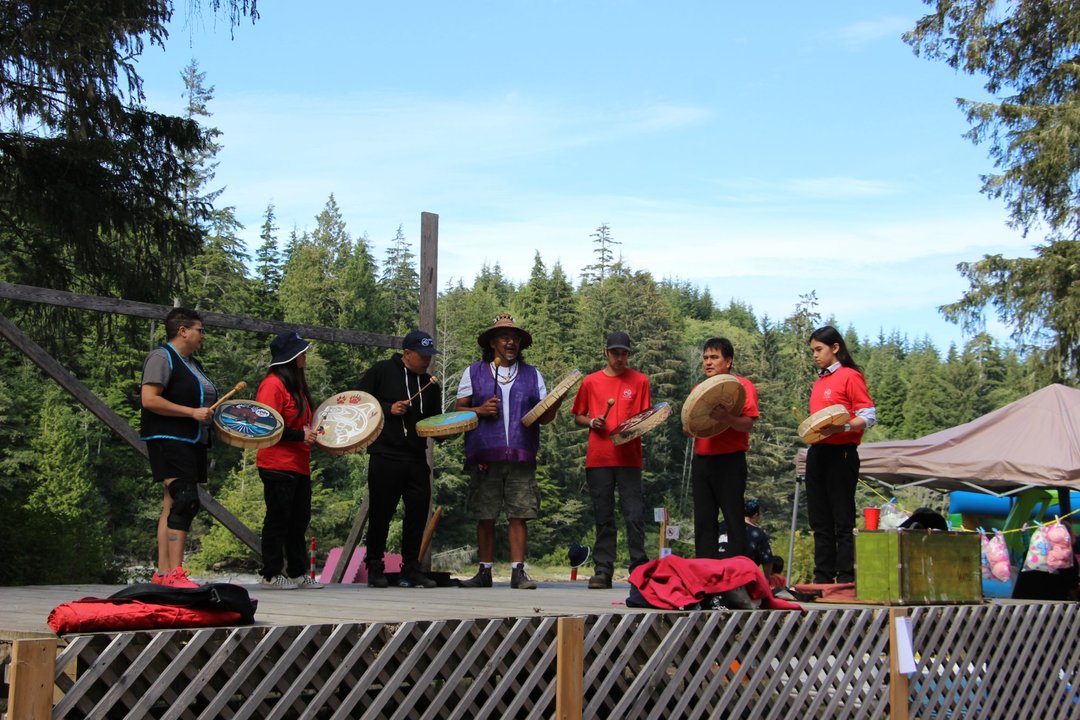
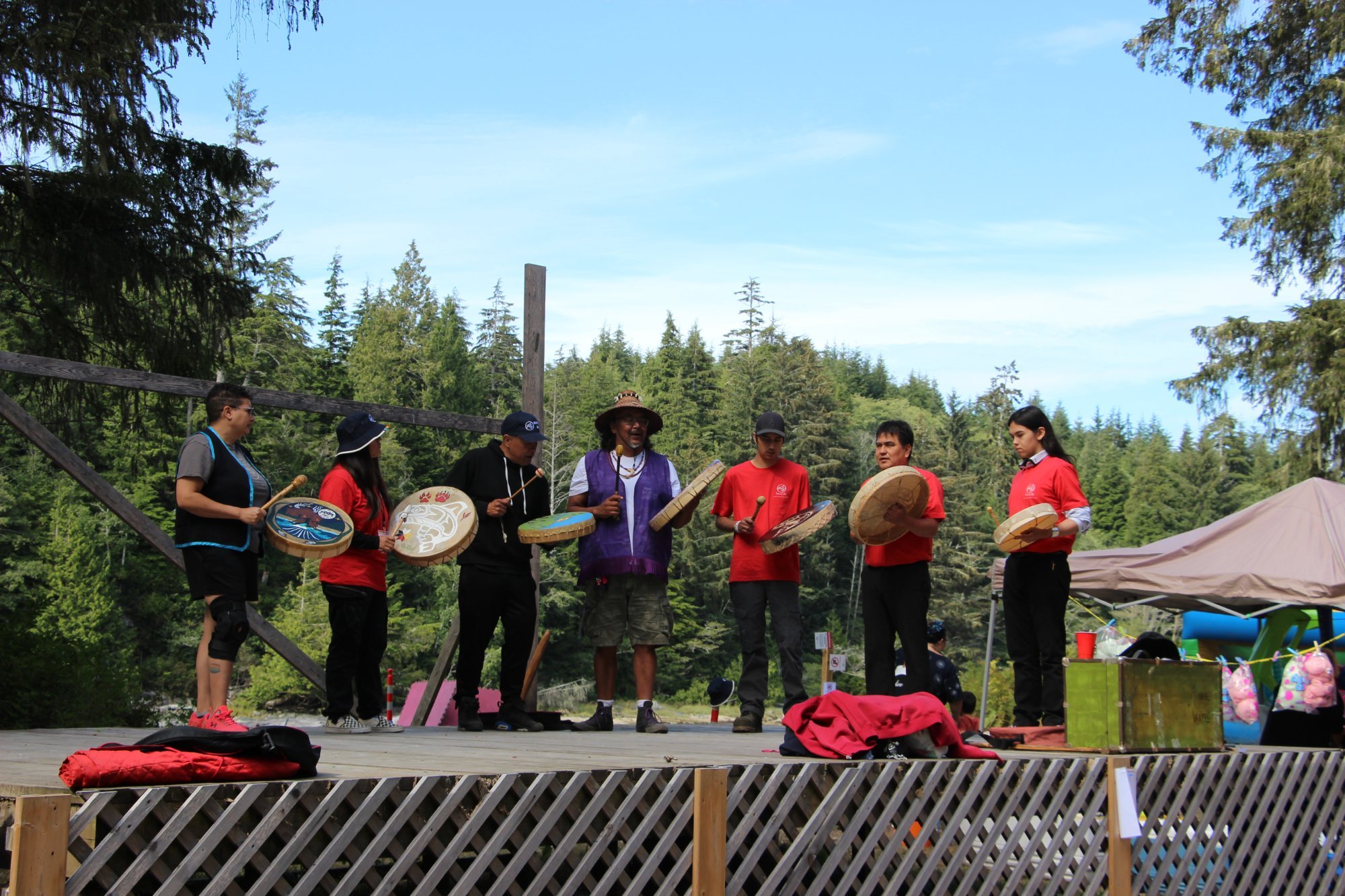
Culture and traditions are the core of who we are as Huu-ay-aht people. Culture and traditional teachings are carried through stories, hereditary rights, songs, and ceremonies that have been safeguarded by generations of ḥaw̓iiḥ (hereditary chiefs) and families. The Nation is committed to passing down knowledge about history, places, and identity, especially to those who were raised away from their homelands or who are reconnecting with Huu-ay-aht culture and traditions.
If you were raised outside Treaty Settlement Lands (TSL) or are curious about Huu-ay-aht traditions, these are some frequently asked questions about cultural practices that we have gathered from other citizens.
Frequently asked questions
Eagle Down is used for cleansing. Down is a layer of fine feathers under the exterior feathers on a bird. First Nations use Eagle Down in ceremony to cleanse or seek success for important business. For instance, on April 22, 2015, it was used as part of the official inauguration of Port Alberni Paawats. It is also used at potlatch to cleanse the floor before a function.
Another example of cleansing is preparing for a potlatch. Quuʔus perform ʔuusimč (ritual bathing) in the river at sunrise. Praying and cleansing, thanking n̓aas (the Creator) for the day and helping them to go through it well.
When the House of Huu-ay-aht opened, 26 people were carefully prepared for the occasion, their presence carrying deep spiritual purpose and discipline. Those present may have observed the cultural black markings painted across their faces, crafted from ash. These markings signalled that each individual had undergone vital cleansing for the day, consciously releasing whatever negativity, burden, or conflict they held in their daily lives. To receive these markings, only the ḥaw̓iiḥ and their head singers or speakers are allowed to apply them. When the dancers go home, they must wipe it off and burn the tissue or cotton pads used for that purpose.
Regalia means all our traditional outfits, i.e. hats, shawls, cedar dresses and headbands. Anything that is worn in ceremonies and cultural functions.
You can give regalia away any time. Usually, if you are going to ask about a cultural topic, to be taught about something, you bring a token of your appreciation to say thanks, whether is a jar of fish or regalia.
Other non-Huu-ay-aht people can buy them as souvenirs, always bearing in mind that they must be handled with respect.
The shawl is part of the regalia worn to dance. To wear it, wrap the length of the shawl around your body, tie the neckline and tuck both sides in the middle with a safety pin.
The design represents the family/house to which the person belongs to. You have to ask the head of your house for your design. Shawls are usually black. However, they can be white, blue, or red. Among our citizens, designs can include i.e. thunderbirds, bears, wolves, eagles or whales. They are sacred animals and deserve respect.
Make sure there are not decorations hanging or loose threads on your shawl. They can cause an accident. When you dance, you are bringing the design to life with every movement. A shawl must never be left unfolded on chairs or the floor. Whenever you take it off, you must fold it carefully, keeping the design inside.
Dancers should not wear their shawls until the time to dance comes. You must remove your shawl when going to the washroom or doing other activities such as taking pictures or eating. Dancers must take the shawls off their shoulders and carry them in one arm. Shawls are only worn behind curtain or on the dance floor.
While dancing in a potlatch, dancers preparing to dance should not be noisy or chat among themselves unless they are guiding inexperienced dancers through the upcoming steps. Dancers must not wear street shoes. It is forbidden to chew gum. They must not touch their faces, make funny gestures or play with their hair.
If you have anything in your shawl or regalia hanging, you must check before dancing, because there are liability issues associated to accidents. If something falls off and someone else picks it up, the person might ask the family to correct it by paying a fine. The person whose regalia it fell from will get up and give a loonie or toonie to the host.
Two ḥaw̓iiḥ (Hereditary Chiefs), or their wife/husband, can declare a mistake and challenge it by requesting either an apology or another party.
If a dancer requires use of a walker and or have any mobility or health challenges, it is best to attend dance practice so that we can plan how the performance will be modified to accommodate your participation. Huu-ay-aht must always consider liability issues when planning any activity.
Dancing, singing and drumming are healthy, help to overcome trauma, increases your energy and gives you a sense of belonging. It is a way of regaining yourself and your cultural identity.
Singing and drumming are introduced before children are born. They hear it while in the womb. Women who are expecting a child, however, must not dance. During functions, spiritual beings are called and bad energy is swept from the floor. Babies are so pure and susceptible that there is the risk of losing them to the spirit world. It is the responsibility of the grandparents to take care of children and determine what they are good at. If they are good singers, they will be encouraged to sing.
When Huu-ay-aht Singers/Dancers are invited to perform at any function including another Nation (i.e. Tseshaht), you can dance or sing. For instance, a person with a Huu-ay-aht father and Ditidaht mother may join Huu-ay-aht or Ditidaht. It is always good to ask for permission first to avoid embarrassing your family. With the dinner song, many women stand up to dance to honour previous relationships or because their children and relatives have ties with other Nations. Huu-ay-aht like to encourage people to join them in dance (e.g. staff, guests, or partners).
You can practice at home. Please take into account that when you participate in an event knowing that singers do not have the right to use a song, it is inappropriate. You are only allowed to use a song when you have permission to do so. That can be granted once, be unlimited or just for a certain period. It is up to the ḥaw̓iił (Hereditary Chief) that owns the song. When a song is composed, it is made for and given to ḥaw̓iił, only they can give permission for their song to be used.
Naming ceremonies happen when you appear to be in a new stage of your life. Names change with age, i.e.: babyhood, childhood, adolescence, adulthood, old age. Relatives suggest the name change and the ceremony is performed by the head of the corresponding house. When enough people have asked for their names, they will either put on a dinner or a potlatch. They need members of the community to witness the naming.
Each house has a certain amount of names available. They will select an appropriate one. If they do not know anything about the person requesting a name, because they comes from another place such as Calgary, they will ask questions to family members about his or her personality, activities, likes and dislikes.
Citizens can also take over a name after someone has passed or changed his. Remember to inform the relatives of the deceased and the head of the family prior using it.
A house is composed of several families whose lineage is associated to one of the hereditary chiefs. These chiefs are called the “ḥaw̓iiḥ Council”:
- Oliva Peters (t̓ayii ḥaw̓ił ƛiišinʔas) – ʔApwinisatḥʔ house
- Theresa Nookemus (Thlut’ as aksup) – Ḥaw’eḥtak’amłatḥ house
- Phyllis Williams (Kiyakinux̣) sitting in for daughter Victoria Williams (ʔuutstuʔaksa)- ƛamahuus house
- Andy Clappis (Ciicaacistuł) – Kuukw’iis house
- Sherri Cook (Yaalthuuaa-uks)– Yaałuuwaštak̕amałtḥ house
- Tommy Happynook (ḥapinyuuk) – Čačaaḥsiʔas house
- Alec Frank (ƛaacmiik) – Maatsaas house
Please contact the head of your family to obtain guidance on the subject. If you need to contact your head of house and do not know who they are or how to contact them, please call the office and we would be happy to assist you.
A potlatch has been used for different ceremonies such as coming of age for girls (first menstruation) and boys, celebrations of life, naming, handing down of a seat, wedding anniversaries, etc. A potluck is unofficial and more about people meeting and bringing different dishes to share.
The wolves were young people with a special talent for ceremonies. Once they were identified, they were taken to an island until they received a song from n̓aas and came back home.
The wolves are not used very often. They are very sacred. They participate in certain ceremonies. For example, taking a person of high standing who has died to the graveyard.
The Sarita is the most important of the thirty five rivers and creeks in Huu ay aht territory, and we call it . Huge runs of salmon, numbering in the tens of thousands, supplied generations of our people with a secure and plentiful source of food. also permitted easy travel from the ocean to upland areas in Huu ay aht territory, and to elk, deer, bear, trout, lakes, camps, and sacred sites. Huu ay aht histories record that for thousands of years the Sarita River was the location of numerous villages and other important sites. The most important is Nuumakimyiis, a traditional winter village located at the mouth of the river. Near the mouth of the Sarita River, at the foot of Poett Heights mountain, there is a grove of red cedar that were once our primary source of wood and cedar bark. Today, this grove of cedar is remarkable for the scores of culturally modified trees (CMTs) that bear witness to the activities of generations of Huu ay aht. Some of the trees have scars where cedar bark was stripped away for use in basketry or clothing; other trees were felled to secure wood for making houses, canoes, boxes and many other items. The cedar in this grove form the largest known traditional forestry area in all of Huu ay aht territory. Logging in the 1950s and 1960s reduced the natural buffer along the main channel of the Sarita River and also in the upper reaches of the watershed. This resulted in damage to fish habitat in the river through channel widening, the in filling of pools, reduced surface flow, and the loss of woody debris. In recent years, much has been done to mitigate this damage through the cooperative efforts of Huu ay aht First Nations and their partners. You can learn more about these initiatives and the history of our territory on our .
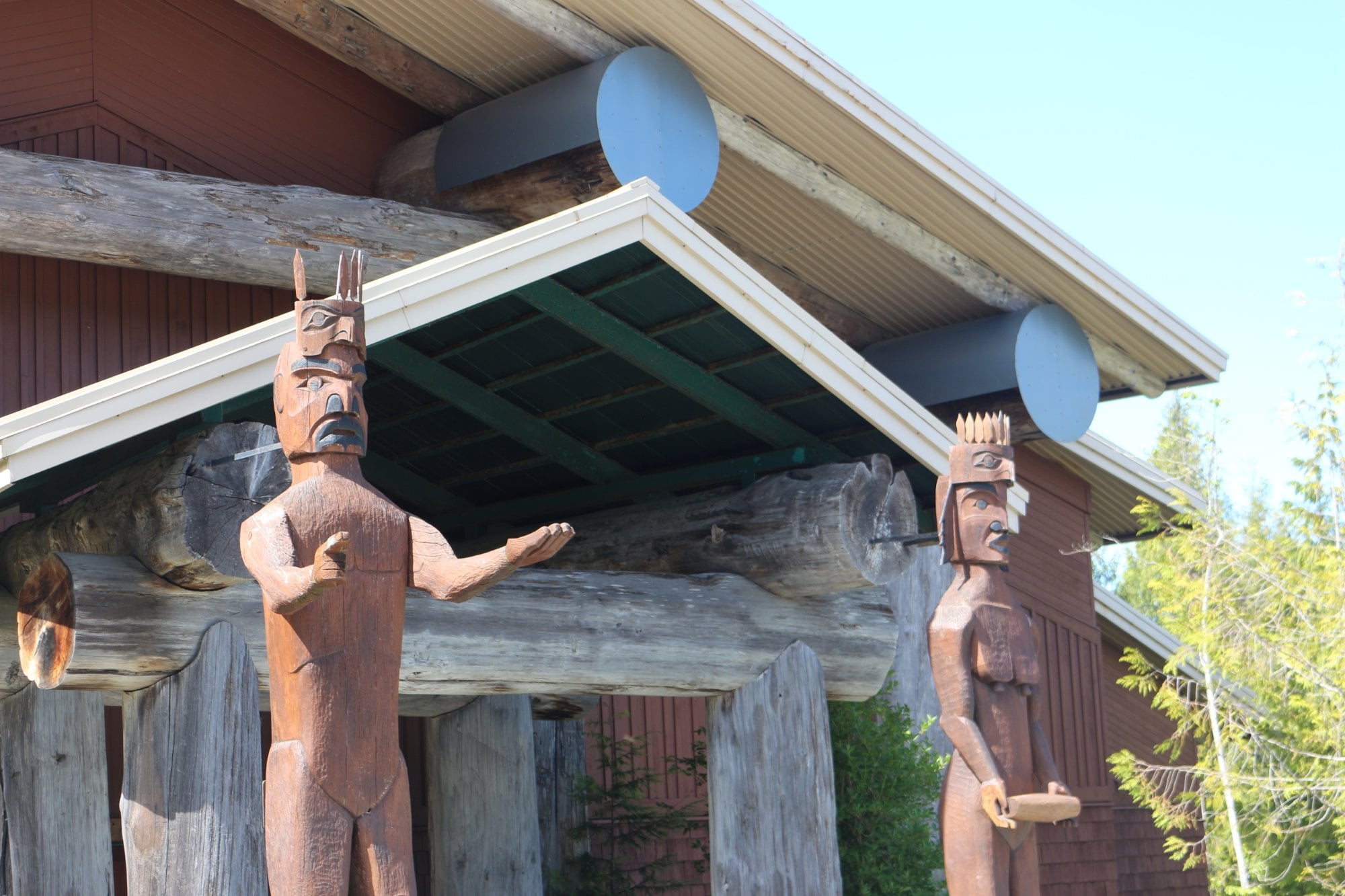
In Huu-ay-aht traditions, the resources of the forest, particularly the cedar tree, have special significance. Cedar wood and cedar bark both defined and surrounded the lives of Huu-ay-aht ancestors. From the time a newborn baby was swaddled in finely shredded bark and laid in a cedar cradle, to the time of death when one was wrapped in a cedar bark blanket and laid in a cedar coffin, cedar was an important part of everyday life. The Huu-ay-aht lived in cedar houses, cooked in cedar boxes, traveled in dugout cedar canoes, wore cedar bark clothes, and gathered and stored food in cedar baskets.
As recalled by elder Liz Happynook, groups of Huu-ay-aht women would travel to known groves of good cedar to obtain tree bark. A prayer of respect would be offered to the selected tree before the bark was stripped from the trunk. Next, the outer bark was peeled off, and the inner bark bundled and carried home. Using a variety of techniques, the bark was processed into a soft, flexible material that found many uses: bags and baskets, mats, box covers, diapers, hats, belts, rope, capes, blankets, nets, towels, amulets and more. Similarly, cedar trees were cut down, and the wood used for numerous purposes: houses, canoes, boxes, dishes, utensils and more. Trees that had bark removed from them decades ago, even centuries, today bear the scars. Trees cut down, or with wood removed, are also found today. They are known as culturally modified trees, or CMTs.
Within Huu-ay-aht traditions cedar, and its bark, are considered to have supernatural and healing qualities. Our stories tell us that cedar bark is regarded as medicine by supernatural beings, and that people traded it to gain special powers. Cedar bark was always an important component of healing ceremonies. The spirits of the cedars had to be treated with respect. People must prepare through the rituals of Uusimch for success in collecting cedar wood and bark, and for other ventures such as hunting, fishing or whaling.
Uusimch involves a cleansing bathing ritual, immersing oneself in cold water, scrubbing the body with bundles of medicine plants, sometimes including cedar bark, fasting, and offering prayers to the four Supernatural Chief deities.
Explore Culture & Language
News and updates