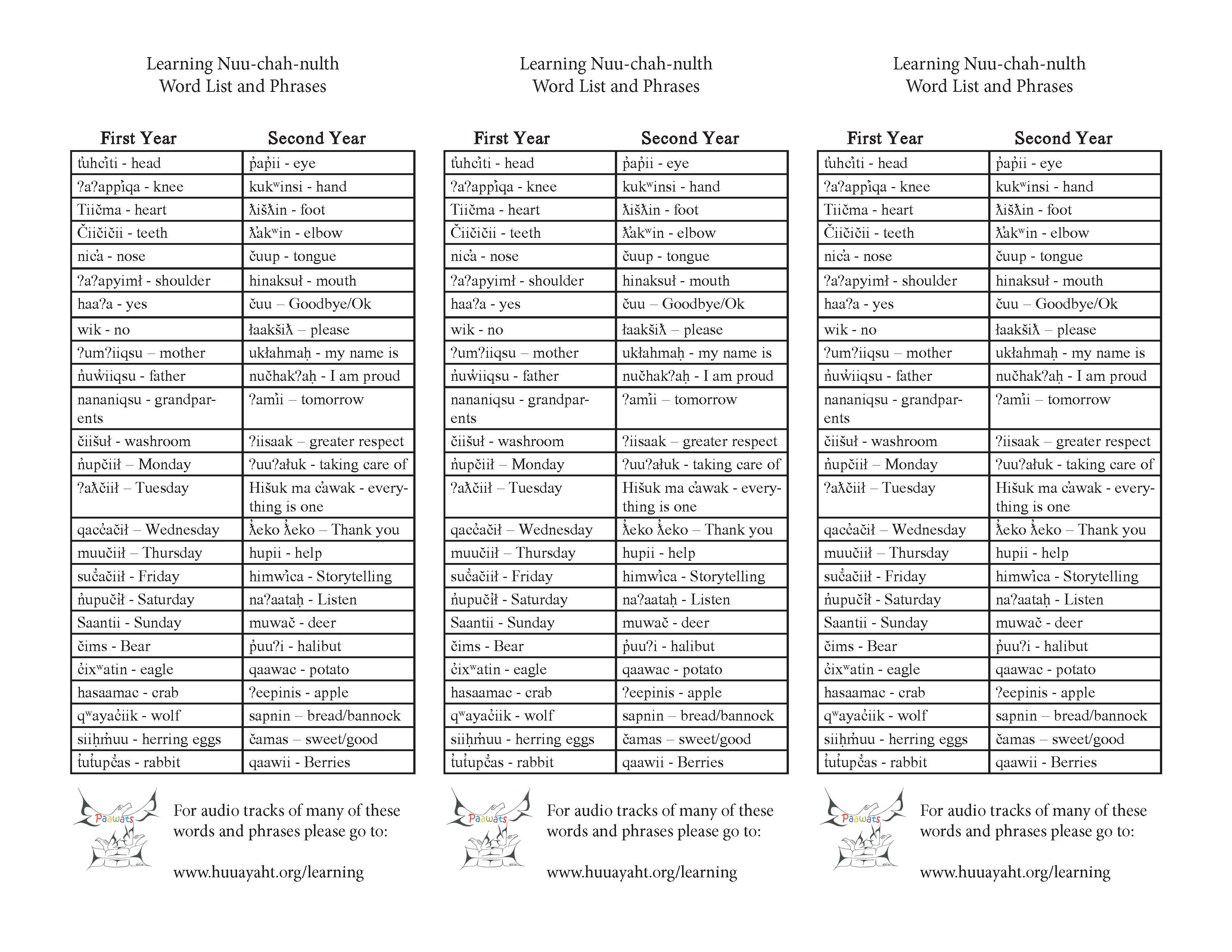



Nuu-chah-nulth is the language of the Huu-ay-aht First Nations and the other Nuu-chah-nulth nations of the west coast of Vancouver Island.
Where the language comes from
Nuu-chah-nulth belongs to the Wakashan language family. It is spoken along the west coast of Vancouver Island, from Barkley Sound to Quatsino Sound.
The Huu-ay-aht dialect is part of the Barkley Sound dialect, shared with the Ucluelet, Uchucklesaht, and Toquaht nations.
Language is a spoken medium, whereas writing is an approximation of language. Writing languages is important because it provides the opportunity for repetition and, therefore, the opportunity to learn.
Nuu-chah-nulth Phrasebook, Barkley Sound Dialect
Keeping the language alive
Today Nuu-chah-nulth is being actively revitalized. Language programs, sound recordings, and learning resources help a new generation of speakers learn the language at home, at school, and in the community.
Phrasebook · Barkley Sound Dialect
These phrases come from the Nuu-chah-nulth Phrasebook, Barkley Sound Dialect, by the Barkley Sound working group — Huu-ay-aht, Ucluelet, Uchucklesaht, and Toquaht First Nations. Each phrase has the English, the “easy read” pronunciation, and the Nuu-chah-nulth spelling. Play the clip to hear it.
Introductions & Greetings
ʔukłaamaḥ
Ook-tlha maḥ
My name is…
ʔačaqłeḥak
A-chuk thle ḥuk
What’s your name?
Waasiḥak
Waas-si ḥuk
Where are you?
ʔačaqukḥak ʔuw̓aat̓in
A-chuk-khook ḥuk oo-wah-tin
Who is your relative?
Čitakinʔaała n̓ačuʔał suw̓a
Chit-tuk in authla na-chu-ulth su wa
We are happy to see you.
Čitakaḥ ʔaała n̓ačuʔał suw̓a
Chit-tuk kaḥ authla na-chu-ulth su wa
I’m happy to see you.
ʔaaqinʔaƛḥak
Au-khin utl ḥuk
How are you?
Čačimḥiḥasuu
Cha-chim-ḥe ḥa su
Are you all okay?
ʔuʔaałukʔiʔaała
Oo-authl-tlook e authla
Be careful.
Čuušukḥʔičʔaała
Tsu-shukḥ itch authla
You all be careful.
N̓aač̓ałukičʔaała
Na-cha-tlook itch authla
You all be careful.
ʔuʔaałukičʔaała
Oo-authl-tlook itch authla
You all be careful.
Č̓uušukḥʔi ʔaała
Tsu-shukḥ itch authla
You be careful.
ʔuʔaałuki quqʷaasʔi
Oo-authl-tlook e khu-kwaas e
Look after other people.
Huuʕiiʔatḥin
Huu-eeḥ-atḥ ḥin
We are Huu-ay-aht.
Huuʕiiʔaqsumaḥ
Huu-eeḥ-uk su maḥ
I am a Huu-ay-aht woman
Huuʕiiʔat ḥaḥ
Huu-eeḥ-atḥ haḥ
I am a Huu-ay-aht man.
Huuʕiiʔat ḥaḥ
Huu-eeḥ-atḥ haḥ
I am a Huu-ay-aht man.
Hiy̓atḥin
He-yaht ḥin
We live at…
Hiy̓atḥaḥ
He-yaht ḥah
I live at…
Personal Phrases
Ook-tlah-maḥ (koo-a-tseets eḥm-tee) -ʔukłaamaḥ quʔaciic ʕimtii
My First Nations name is… (Indian name)
ʔaḥ ʔaaʔaƛ ma mamałn̓I ʕimtii
Uḥ a utl mah ma-multh-ni eḥm-tee
And my English name is…
ʔuhukʷaḥ ʔumʔiiqsu ʔaḥʔaaʔaƛ n̓uw̓iiqsu
Ooḥ-hook kwaḥ oom-eekh-su aḥ a utl noo-weekh-su
My Mom and Dad (parents) are…
Histaqšimaʔał ʕanaqƛ̓a
Hiss-tukh-shitl ma ulth (anacla)
They both came from…
ʔunaakukʷaḥ n̓uw̓iiqsu ḥačimsiqu
Oo-nauk kook kwaḥ noo-weekh-su ḥah-chim-sikh-su
My dad has a brother.
ʔunaakukʷaḥ n̓uw̓iiqsu ḥaḥačimsiqu
Oo-nauk kook kwaḥ noo-weekh-su ḥa-ḥah-chim-sikh-su
My dad has brothers.
ʔunaakukʷaḥ n̓uw̓iiqsu łuučm̓uup
Oo-nauk kook kwaḥ noo-weekh-su tlootch-mhoop
My dad has a sister.
ʔunaakukʷaḥ n̓uw̓iiqsu łuučm̓uupm̓inḥ
Oo-nauk kook kwaḥ noo-weekh-su tlootch-mhoop minḥ
My dad has sisters
ʔunaakukʷaḥ ʔuumʔiiqsu ḥaḥačimsiqsy
Oo-nauk kook kwaḥ oom-eekh-su ḥa-ḥah-chim-sikh-su
Mom has brothers.
ʔunaakukʷah-ʔuumʔiiqsu ḥaḥačimsiqsy
Oo-nauk kook kwaḥ oom-eekh-su ḥah-chim-sikh-su
Mom has a brother.
ʔunaakukʷaḥ ʔuumʔiiqsu łuučm̓uupm̓inḥ
Oo-nauk kook kwaḥ oom-eekh- su tlootch- mhoop minḥ
Mom has sisters.
ʔunaakukʷaḥ ʔuumʔiiqsu łuučm̓uup
Oo-nauk kook kwah oom-eekh-su tlootch-mhoop
Mom has a sister.
ʔayaakaḥ łuučuupm̓inḥ ʔaḥ ʔaaʔaƛ ḥaḥačimsiqsu
A-ya kaḥ na-ne-eekh-su
I have lots of uncles and aunts.
ʔayaakaḥ łuučm̓uupm̓inḥ ʔaḥ ʔaaʔaƛ ḥaḥačimsiqsu
A-ya kaḥ tlootch-mhoop minḥ uḥ a utl ḥa-ḥah-chim-sikh-su
I have many cousins/siblings.
Ḥačataksakaḥ ʔuw̓aat̓in
ḥa-cha-tuk sa kaḥ oo-wat-in
All these people are my relatives.
T̓aat̓nanakukʷaḥ čakup
Taht-na nuk kook kwaḥ cha-koop
My husband has children.
hačatakma ḥaatḥaakʷaƛ
ḥa-cha-tuk ma ḥaht-ḥa-kwahtl
They are all girls.
ʔunaakin ʔaʔaasiqsu
Oo-nauk kin a-ah-sikh-su
We have nieces.
ʔunaakin wiiwiiʔuu
Oo-nauk kin we-we-oo
We have nephews.
Meʔiƛqac ʔisma
Meh-itl-khuts iss ma
It’s a little boy.
Ḥaakʷaaƛ ʔisma
ḥa-kwahtl iss ma
It’s a little girl.
Łiciitšiƛaḥ
Thlee-tseet shitl tlaḥ
I got pregnant.
Nay̓aqnakšiʔaƛaḥ
Na-yukh-nuk she utl taḥ
I had my baby.
ʔanaqʔičḥšiʔaƛḥak
A-nukh-itcḥ she utl ḥuk
How old are you?
ƛiḥaqšiʔaƛaḥ
Tlee-ḥuk she utl tlaḥ
I’m thin.
ƛihaqšiƛšiʔaƛaḥ
Tlee-ḥuk shitl she utl tlaḥ
I lost a lot of weight.
Kʷatyiikšiʔaƛaḥ
Kwat-yeek she utl tlaḥ
I put on a lot of weight.
T̓aneʔisma meʔiƛqac
Ta-ne-is ma
She/he is young.
T̓aneʔisma ḥaakʷaaƛʔi
Ta-ne-is ma ḥa-kwatl e
She is very young.
T̓aneʔisma meʔiƛqac
Ta-ne-is ma meh-itl-khuts
He is young.
ʔiičimmałaƛma
Ee-chim maa utl ma
He/she is very old.
Maaqaw̓uʔaƛqas
Mah-khah we utl khus
I’m going blind.
ʔusim ʔaƛqas pipiihy̓aksim
Oo-sim utl khus pi-piḥ-yukh-sim
I need glasses.
ʔusimʔičI ʔaƛḥak pipiiḥy̓aksim
Oo-sim e che utl ḥuk pi-piḥ-yukh-sim
Do you need glasses?
Wahaakw̓it̓asaḥ ʔuuštaqyuʔi
Wah-haak wit us aḥ oosh-tukh-yu e
I am going to see the doctor.
Wahaakw̓it̓asaḥ ʔuuštaqyuʔi
Wah-haak wit us aḥ oosh-tukh-yu e
I am going to see the doctor.
ʔusimmaḥ našiƛ ʔuušstaqyuʔi
Oo-soom maḥ na shitl oosh-tukh-yu e
I need to see the doctor.
ʔusimmał ʕuy̓i
Oo-soom maḥ ooḥ-yi
I need medicine.
N̓aačpanač ʔaqƛaḥ ʔuw̓aat̓in
Nahtch-pa-nutch uktl tlaḥ oo-wah-tin
I want to visit my family.
N̓aačpanač mesamaḥ qʷiqʷiiqsu
Nahtch-pa-nutch maḥ sa maḥ kwe-kwe-eekh-su
I want to visit my in-laws.
ʔuʔuʔiih w̓it̓asinuk c̓it̓apt
Oo-oo-eeḥ wit us in uk che-tupt
Lets go pick basket grass (swamp).
ʔuʔuʔiih w̓it̓asaḥ c̓it̓apt
Oo-oo-eeḥ wit us aḥ che-tupt
I’ll go pick basket grass (swamp).
ʔuʔuʔiih w̓it̓as ʔin t̓ux̣t̓ux̣
Oo-oo-eeḥ wit us in tugh-tugh
Lets go pick basket grass (sedge-t`ut`unaxk`uk).
ʔuʔuʔiiḥ w̓it̓asinuk pic̓up
Oo-oo-eeḥ wit us in uk piih-tsuup
Lets go pick cedar bark.
Č̓ič̓t̓apt̓iihin
Che-che-tapt eḥ in
Lets go pick swamp grass.
Land & Properties
N̓ism̓aakqin
Nis-mak khin
Our land.
ʔayama nučii
A-ya ma nuu-chee
There are many mountains.
Sayaač̓ama nučii
Sa-ya-cha ma nuu-chee
There are high mountains.
ʔuušmaa ʔanaač̓aʔis nučii
Oosh-ma a-na-che-is nuu-chee
Some mountains are low.
ʔa naačaʔis nučii
A-na-che-iss nuu-chee
Low mountain.
Čiic ʔaqƛ ʔuḥukʷitin m̓in̓aał nučiim̓imḥʔi
Cheets-uktl ooḥ ḥook kwit kin min aulth e nuu-chee minḥ e
Fishermen used mountains as landmarks.
Nučii hist̓atḥukin ʔała ʕałmapt
Nuu-chee hiss-tukh hḥook kin authla uḥtl-mupt
We get yellow cedar off the mountains.
ʔuuḥw̓inkitinʔaała ḥumis hiihiqstupiił
Ooḥ-wink kit kin authla ḥo-miss he-yiks-stup-eelth
We use cedar for many of our needs.
ʔayaaqin ʕaʔuk hił nismaakqin
A-ya kin aḥ-ook hilth nis-mak-khin
We have lots of lakes on our land.
ʔuyiiʔatin ʔaała č̓ałak ʕaʔukm̓inḥ
Oo-ye ut in aulth cha-uck aḥ-ook-minḥ
These lakes give us water.
Histaqšiƛukin č̓aʔak ʕaʔukʔi
Hiss-tuk-shitl tlook kin cha-uck aḥ-ook-e
Our water comes from the lake.
Hiłqinʔaał ʔuusimč ʕaʔukʔ
Hiltḥ khin authla oose-siimtch aḥ-ook-e
We have ritual baths in these lakes.
Hiłḥqin ʔaała susmałn̓I ʕaʔukʔi
Hiltḥ khin authla soose-malthni aḥ-ook-e
We swim in lakes.
ʕiiḥcamisukin ʕaʔukm̓inḥʔi
Eaḥ-tsah-mis suk kin aḥ-ook-minḥ-e
Lakes are very important places in our land.
ʔunaakin c̓aʔak hił nism̓aakqin
Oo-nauk kin tsa-uck hilth nis-mak-kin
We have rivers on our land.
Histaqšiƛqa c̓aʔak ʕaʔukʔi
Hiss-tukh-shitl kha tsa-uck aḥ-ook-e
The river comes from the lake.
ʔuyiiʔatin naqy̓ak č̓aʔak c̓aʔakm̓inḥ
Oo-ye ut in aulth tsa-uck minḥ cha-uck
Rivers give us drinking water.
C̓aʔukʔi histaqšiƛukin č̓aʔak
Tsa-uck e hiss-tukh-shitl tlook kin cḥa-uck
Our water comes from the river.
Hiłḥ qaaʔaała saminʔaḥ y̓akšiƛ c̓aʔakm̓inḥi
Hiltḥ ka authla saumin aḥ-yak-shitl tsa-uck-minḥ-e rivers.
Salmon start their lifecycle in the rivers
ʔayaakqin qawiištup nim̓aakqin
A-ya khin khaweesh-toop nis-mak-khin
Our land has many different kinds of berries.
ʔuyiminʔaała qaqaway̓iiḥ ƛ̓up̓iičḥʔaƛquu
Oo-yee min authla kha-kha-wa-yheeḥ tlu-piicḥ utl koo
We pick berries in the summer.
ʔuʔiisqinʔaała m̓ayii
Oo-eese khin authla mah-yee
We eat young salmonberry stalks.
ʔuʔiisqinʔaała č̓aašxiwa
Oo-eese khin authla chaush khe-wa
We eat young thimbleberry stalks.
ʔaanasakitin čaʔmastup huuʔak
A-na suck kit khin cha-mus tuup hoo-uck
Long ago, these were our only treats.
ƛ̓uščuumitma qawiim̓inḥ čaʔmasy̓ak
Tloosh-choo mit ma kha-wee minḥ cha-ma yak
Berries were dried for treats.
ƛ̓uščuuʔakqin qawii
Our berries are dried. -Tloosh-choo uck khin kha-we
ƛ̓uščuuʔakqinʔaała haʔum ʔuy̓ak c̓uʔičḥ
Tloosh-choo uck khin authla ha-oom oo-ye-yuck tsu-iich
Our foods were always dried for winter use.
Histaqšiƛłukʷitqin hihiqstup nism̓aakqin
Hiss-tuck-shitl tlook-kwit khin he-yikh-stuup nis-mak khin
Everything we have came from the land.
ƛ̓aqaʔus histaqšiƛ łukininksy̓I ƛ̓upmiił aḥne
Tla-kha-us hiss-tuck-shitl tlook-khin inks-yeh tloop-meelth aḥ ne
We got firewood from the trees.
ʔanač̓asʔisma nuučii
A-na-che-iss ma nuu-chee
The mountain is low.
About My Home
ʔuucaaḥ maʔas
Oots-tsaḥ mah-us
This is my house.
ʔuucin maʔas
Oots-in mah-us
This is our house.
ʔuucw̓it̓asin maʔasʔi
Oots wit-us in mah-us e
That is going to be our house.
T̓ašii ʔuʔałukaḥ maʔas
Tah-she oo ulth tlook aḥ mah-us
My house has a door.
M̓ušʔasim
Muush-us-sim
A door.
T̓ašii
Tah-she
A pathway. (door-way, roadway)
Hiłst̓uʕasukqaḥ(qas) m̓ušʔasim maʔasukqas
Hitlh-stoo-us sook kaḥ muush-a-sim mah-us sook khus
My house has a back door.
T̓ašii ʔuʔałukʷin maʔas
Tah-she oo ulth tlook kwin mah-us
My house has a door.
ʔustʔiłnakukʷaḥ maʔas
Oo-stilth nak kook kwaḥ mah-us
My house has a floor.
ʔustʔiłnakukʷin maʔas
Oo-stilth nak kook kwin mah-us
Our house has a floor.
ʔuʔnaakukʷaḥ yacac̓us maʔas
Oo-nauk kook kwaḥ ya-tsa-tsus mah-us
My house has stairs.
ʔuʔnaakukʷaḥ yacac̓us hiłst̓ʕas maʔas
Oo-nauk kook kwaḥ ya-tsa-tsus hilth-stu-us mah-us
My house has back stairs.
Mačiiłukʷin yacac̓us maʔas
Mah-cheelth thlook kwin ya-tsa-tsus mah-us
Our house has stairs inside.
Hinimsinƛma yacac̓usʔi
Hin-nim-sintl mah ya-tsa-tsus e
Those stairs go up.
Macčinuʔi maʔasukqas
Ma-che-noo e mah-us sook khus
Come into my house.
Mačinuʔi maʔaskukqin
Ma-che-noo e mah-us sook khin
Come into our house.
ʔunaakukʷaḥ maʔas hinałc̓a
Oo-nauk kook kwaḥ mah-us hin-naulth-tsa
My house has a roof.
Caḥaaʔakin hinałc̓a
Tsa-ḥa uck kin hin-naulth-tsa
Our house has a leaky roof.
Wikukʷaḥ caḥaa hinałc̓a maʔas
Wik kook kwaḥ tsa-ḥa hin-nautlh-tsa mah-us
My house does not have a leaky roof.
Wikukʷin caḥaa hinałc̓a maʔas
Wik kook kwin tsa-ḥa hin-nautlh-tsa mah-us
Our house does not have a leaky roof.
At Home
ƛupkšiʔaƛi
Klupk-she utl ee
You wake up.
ƛupkšiʔaƛič
You all wake up. -Klupk-she utl itch
ciciqink̓i
Tsi-tsi-khink ee
Say your prayers.
Ciciqink̓ičʔaała
Tsi-tsi-khink itch authla
All of you say your prayers.
ƛ̓upšiʔaƛ̓̓i
Khluup-she utl ee
Wash your face.
C̓uc̓inkuʔaƛ̓i
Tsu-tsink-ku utl ee
Wash your hands.
M̓uč̓ičuʔaƛi
Mu-chi-chu utl ee
Get dressed.
M̓uč̓ičuʔaƛ̓ič
Mu-chi-chu utl itch
You all get dressed.
ʔayač̓ičʔaƛ̓im
A-ya chitch utl im
Dress warmly.
ʔayač̓icʔaƛ̓ičim
A-ya chitch utl itch im
All of you dress warmly.
ʔuumʔis
Ohm-iss
All moms.
ʔuumʔ
Ohm-ii
Your mom.
N̓uuw̓is
Noh-wiis
Dad.
Y̓ukʷiiqsu
Yhu-kwiik-su
Younger sibling.
Y̓ukʷi
Yhu-kwi
Younger sibling. (short form)
Maamiiqsu
Mah-miikh-su
Older sibling.
Mam̓i
Mah-mii
Older sibling. (short form)
Neniiqsuu
Na-niekh-su
Grandmother/Grandfather.
Neneniiqsu
Na-na-niekh-su
Grandmothers/Grandfathers.
ʔeʔiičaʕin
A-ii cha-eḥn
Tell me a story.
Hinii ʕasʕaƛči
Hin-nee-us utl chi
Go outside.
Hitaas šiʔaƛ̓ič pisatuk
Hii-tahs she utl tsu pi-sa-took
All of you go outside and play
łaakšiʔi c̓uc̓umy̓aḥs
Tlak-she-ii tsu-tsum-yuhtsum-yuḥs
Please wash the dishes.
łakšiʔi yaxmiił
Tlak-she-ii yugh miilth
Please sweep the floor.
ƛaḥinkšiƛin
Tlah-ḥink shitl tlin
We just got together (as in a marriage).
ʔukłaama yaqcḥiqas
Ook-tla-ma yhukts ḥe khuss
My spouse’s name is…
T̓aatn̓anakin
Taut-na nuc kin
We have children.
taatneʔis ʔunaakin
Taut-na iss oo-nauk kin
We have small children.
ʔunaakaḥ ḥaw̓iiḥaƛ
Oo-nauk aḥ ḥa-wii ḥutl
I have sons. (my sons)
ʔunaakaḥ ḥaatḥaakʷaƛ
Oo-nauk aḥ ḥaht-ḥa-kwatl
I have daughters.
Kakuucnakaḥ
Ka-koots na kaḥ
I have grand-children.
ʔunaakin kakuuc
Oo-nauk in ka-koots
We have grand-children.
Haaʕinʔaqƛin neneniqsu
Ha-eḥn uck tlin na-na-niekh-suu
We’ll invite the grandparents for a meal.
Siqnaakši ʔaqƛaḥ
Sikh-nauk shilt uk tla tlaḥ
I’m going to cook.
ʔaaqiḥc̓a ʔqaaqƛ ḥak
Ah-khits-sa kahtl ḥuk
What are you going to cook?
ʔaqiis ʔaqƛḥak
Ah-khees auktl ḥuk
What are you going to eat?
ʔaqiismeḥsaḥak
Ah-khees maḥ sa ḥuk
What would you like to eat?
Haʕin ʔaqƛin naneʔiqsu
Ha-eḥn uck tlin na-neh-eekh-suu
We’ll invite auntie and uncle (meal is implied).
Ḥaačatił ʔaaqƛin haaʕin
ḥa-cha-tilth uck tlin ḥa-eḥn
We’ll invite others (meal is implied).
ʔuucaaqaʔaqƛaḥ saamin
Oots-sa kahtl tlaḥ saumin
I’ll cook fresh fish.
ʔuucaaqaʔaqƛaḥ ƛ̓ušašt
Oots-sa kahtl tlaḥ klu shusht
I’ll cook smoked fish.
ʔuucaaqaʔaqƛaḥ ʕaatuš
Oots-sa kahtl tlaḥ aḥ-toosh
I’ll cook deer meat.
ʔuucaaqałaqƛaḥ qaawac
Oots-sa kahtl tlaḥ ka-wuts
I’ll cook potatoes.
At School
Huḥtakšiƛin qiicqiica
Huḥ-tuk shitl tlin kheets-kheet-sa
We learned to write.
huḥtakšiƛin huksaa
Huḥ-tuk shitl tlin hook-sa
We learned how to count.
Huḥtakšiƛitaḥ n̓iiqn̓iiqa
Huḥ-tuk she tlit taḥ niik-nii-ka
I learned how to sew.
ƛiiḥpanačitin
Tleḥ-pa-nutch it in
We went on a trip.
ʔink̓ʷiy̓ap̓I tuupʔii
In-kwa-yup e tuup ii
Turn the stove on.
Č̓am̓aqstup̓aƛ̓̓i
Cha-mak-sto up utl ii
Put it in the oven.
Čamaasip̓I niisy̓ak
Cha-maas sip e niis-yhuk
Put the pot on the stove.
ƛułukaḥ yaʔatqas huuḥtakšiiʔap̓at
Tlooth-ook aḥ ya at khus hooḥ-tuk- sheeḥ up ut
I have a good teacher.
wimakḥʔataḥ yaʕatqas huuḥtakšiiḥʔap̓at
Wi-makḥ at aḥ ya at khus hooḥ-tuk-sheeḥ up ut
I don’t like my teacher.
ʔayaakin kʷiishii pisaty̓ak
A-ya kin kwiis-ḥey pis-at-yak
We play lots of different games.
Wiiy̓amaḥ pisatuk
We-ya maḥ pis-a-took
I don’t play games.
ʔuuʔuuqč̓amaḥʔaała tuxšiƛ
Oo-ookh cha maḥ authla toogh-shitl
I like to jump.
Wimakḥʔataḥ tuxšiƛ
We-mukḥ at aḥ toogh-shitl
I don’t like to jump.
Sayaač̓ima tuxšiƛ t̓aneʔis
Sa-yaa-chim ma toogh-shitl ta-na-is
That child jumps high.
wim̓aaqƛma sayaač̓im tuxšiƛ t̓aneʔis
Wi-maktl ma sa- yaa-chim toogh-shitl ta-na-is
That child can’t jump very high.
ʔuuʔuqč̓amaḥ ʔaała kamitquk
Oo-ookh cha maḥ authla ka-mitk-khook
I like running.
Wimakḥʕaataḥ kamitqšiƛ
Wi-makḥ aḥ ta ka-mitk-shitl
I don’t like to run.
ƛ̓ayaxʔaƛma kamitquk t̓aneʔisʔi
Tla yalth utl ma ka-mit-khook ta-na-is e
That child is a fast runner.
wiicxukaƛma kamitquk t̓aneʔisʔi
Wiits-thook utl ma ka-mit-khook ta- na-is e
That child is a slow runner.
ʔayaakukaḥ ʔuuksčiʕin
A-ya kook kaḥ ooks-chaa-eḥn
I have lots of friends.
Kameeʔisukʷaḥ ʔuuksčaʕin
Ka-meh is ook waḥ ooks-chaa-eḥn
I don’t have many friends.
Y̓aaqukʷaḥ ʔuuksčiʕin
Yaakh oo kwaḥ ooks-chaa-eḥn
My friend is tall.
ʔaneḥisukʷaḥ ʔuukčiʕin
A-neh-is oo kwaḥ ooks-chaa-eḥn
My friend is short.
Yaamisukʷaḥ suw̓a
Ya-mis su-kwaḥ su-wa
I like/love you.
Ḥaačatiłaḥ yaamisuk
I like everybody. -ḥa-cha-tihtl aḥ ya-mis-sook
Qʷac̓ałukʷaḥ ʔuuksčiʕin
Qwah-tsulth uk kwaḥ ooks- chaa-eḥn
My friend is good-looking.
Miiłhiimin qum̓aaqʔičḥ
Mithl-ḥey min khooh-makḥ itcḥ
We are the same age.
ʔuuʔuuqč̓amaḥʔaała ʔuuʔuukʷaʔatḥa
Oo-ookh-cha-maḥ authla oo-oo-kwa ut ḥa
I am happy when I’m speaking my language.
Wimakḥʔataḥ nunuuk
Wi-makḥ a taḥ nu-nook
I don’t like singing.
ʔayaakin nuuk
A-ya kin nook
We have lots of songs.
wik̓iis ƛ̓uḥšiƛ
We-kiis klooḥ shitl
Don’t slap me.
Čamułaḥ huks šiƛ
Cha-moolth tlaḥ hooks-shitl
I can count.
Čamułaḥ huksaa
Cha-moolth tlaḥ hooks-sa
I can count.
Qiʔiiʔʔap̓aƛi qicały̓akʔi
Khe-ee-up utl ee khe-tsalth yuk-ii
Put your school supplies away.
ʔuuʔuuqč̓amaḥ huuḥtakšiiḥ hiłḥ qicuw̓asʔi
Oo-ookh-cha-maḥ hooḥ-tuk-sheeḥ hilth khe-tsu waas e
I like to learn in school.
Čamiḥtama yaa naʔaa
Cha-miiḥ-ta ma ya na-ah
That person is very smart. [pointing at-(yalth-ya>)]
Mutch-kalth utl ma- Mačqałʔaƛma
It’s dirty.
Yaxmiipi ʔaƛ̓ʔi
Yugh-me-pi utl ee
Sweep it.
wikʕaaƛšiʔaƛ̓i
Wik-uḥtl she utl e
You be quiet.
wikʕaaƛšiʔaƛ̓ič
Wik-uḥtl she utl itch
You all be quiet
Susinkʷis
Su-sin-kwiis
Hold my hand.
ƛuułƛuułeʔi yaacuk
Tlooth-tlootha e ya-tsuuk
Walk slowly.
ƛ̓ay̓axšiʔaƛ̓I yaacuk
Tlah-yagh she utl e ya-tsuuk
Walk faster.
Wałšiʔaƛ̓in
Walth-she utl in
Lets go home.
P̓us šiʔaƛin
Puus she a tlin
We are tired.
Seasons & Weather
C̓uʔučḥma
Tsu-iitcḥ ma
It’s winter.
ƛ̓aqšiƛma
Tluk-shitl ma
It’s springtime.
ƛ̓up̓iičḥma
Tlu-peetcḥ ma
It’s summer.
ʕay̓iičḥ
Aḥ-iicḥ
Fall time.
Kʷiisḥiičiƛma
Kwees-ḥe chitl ma
The weather is changing.
wiiqsiičI ʔaƛma
Weekl-se che utl ma
It’s stormy.
ʔuuqumḥaƛma
Oo-khoom-ḥutl ma
It’s calm.
Hačłiiƛʔaƛma
Hutch-thleetl utl ma
It’s a west wind right now.
Hačłiiƛ
Hutch-thleetl
West wind.
Yuuwuḥsuʔis
Yu-whaḥ-su-is
East wind.
Yukstiis
Yuk-stees
North wind
Tuč̓ii
Tuu-chee
Southeast wind.
ʔuuqumḥima
Oo-khoom-ḥe ma
The weather is nice.
C̓amiḥtaƛma ʔuuqumḥi
Cha-meḥ tutl ma oo-khoom-ḥe
It’s really nice weather out here.
Wiiwiiquma
We-we-khook ma
The weather is miserable
M̓ałukma
Ma-thlook ma
It’s cold.
ƛ̓uumapi
Tlu-mah pe
It’s warm.
ƛ̓uupaaʔaƛma
Tlu-pah utl ma
It’s hot.
ƛ̓uuƛ̓uuʔapuƛma
Tlu-tlu-a putl ma
It’s too hot.
T̓ałałma
Ta-thlalth ma
It’s wet.
T̓ałʔas ʔaƛma
Tulth-us utl ma
The ground is wet.
T̓ałʔasma
Tulth-us ma
Ground is wet.
ƛ̓uumapaƛma
Tlu-ma patl ma
It’s sunny.
M̓iƛaaʔaƛma hitaas
Mitl-tla utl ma hit-aus
It’s rainy outside.
M̓iƛaa
Mitl-tla
Raining.
Kacaama
Khuts-sa ma
It’s hailing.
łiw̓aḥakma
Thle waḥ ḥuk ma
It’s cloudy.
ʔučqakma
Ootch-khuk ma
It’s foggy.
ʔučqak̓aƛma hitaas
Ootch-khuk utl ma hit-aus
It’s foggy outside right now.
Quux
Kogh
Ice.
Quxʷaaʔaƛma hitaas
Kogh-wa utl ma hit-aus
It’s freezing outside.
Tinḥukma
Tin-ḥook ma
The sea is calm.
P̓išačištma
Phish-sha-chist ma
The sea is rough.
huułapi
Hoo-thla-pe
A mirage.
Ben's Phrases
ʔuḥʔaƛ ḥak
Ooḥ utl ḥuk
Is that you?
ʔaaqinʔaƛḥak
Au-khin utl ḥuk
How are you?
Qiiʔaƛitaḥ wik n̓ačuʔał suw̓a
Khee utl it taḥ wick na-chu-ulth su-wa
I haven’t seen you for a long time.
ʔayaaƛukqačka ʔuyaqḥmis
A-yault tluk khutch-ka oo-yakḥ-mis
You must have lots to tell.
ʔayaaƛukweʔic ʔuyaqḥmis
A-ya utl tlook weh its oo-yakḥ-mis
You have lots of news.
ʔayaaƛukqačka ƛuł ʔuyaqḥmis
A-ya utl tlook khutch-ka tlooth oo-yakḥ-mis
You must have lots of good news.
t̓iqʷaasʔi
Teh-khwas e
Sit down.
T̓iqʷaasiʔaƛ̓i
Teh-khwas se utl e
You sit down.
ʔiiqḥukis hiłitiik
Eekh-ḥook is hithl e teek
Tell me where you were.
Qiikʷaałʔaƛiteʔic
Khee-kwalth utl it te its
You were gone a long time.
ʔuuʔuuqč̓ap̓aƛitḥak
Oo-ookh-chup utl tlit ḥuk
Did you have fun?
ʔuuʔuuqukƛitḥa
Oo-oo-khook tlit ḥa
Was it nice there?
ʔuuqumḥimtḥa
Oo-khoom ḥimt ḥa
Was the weather nice there?
Kʷiishiiʔaƛitḥa hiłitiik
Kwees-ḥee ult tlit ḥa hithl-e-teek
Was it different where you were?
Waascačiƛitḥak
Waas-tsa-chitl tlit ḥuk
Where did you go?
Čačimḥimtḥak
Cha-chim ḥimt ḥuk
Were you okay?
ƛ̓upaaʔaƛitḥa ʔaḥʔaa
Tlu-pa utl tlit ḥa aḥ a
Was it hot there?
ƛ̓upaaʔaƛitḥa ʔaḥn̓ii
Tlu-pa utl tlit ḥa aḥ ne
Was it hot way over there?
ƛ̓upaamitḥa
Tlu-pa mit ḥa
Was it hot?
M̓iƛaamitḥa
Mi-tla mit ḥa
Was it raining?
Miƛšiƛitḥa
Mitl-shitl tlit ḥa
Did it rain?
K̓ʷišiƛitḥa
Kwiis shitl hit ḥa
Did it snow?
K̓ʷisšiƛitma
Kwiis shitl it ma
It snowed.
Yuʔaaƛitḥa
Yu-atl it ḥa
Did it blow?
Yuukʷiʔaƛitma
Yu-kwii-atl it ma
It blew.
yuukʷiƛšiʔaƛma
Yu-kwitl she utl ma
It just started to blow.
ʔayaaƛitḥa quuʔas
A-ya tlit ḥa khoo-us
Were there lots of people?
Čitak̓aƛ̓anitḥasuu n̓ačuʔaałʔat
Che-tuk utl on it ḥa su na-choo-ulth ut
Were they happy to see you?
ʔuuʔuukʷaʔaƛitḥaʔał
Oo-oo-qwe utl tlit ḥa ulth
Did they speak their own language?
Haʔukʔap̓aanitḥak
Ha-ook up on it ḥuk
Did they feed you?
Čamiḥtaʔaanitaḥ ƛuł haʔukʔap̓at
Cha-miḥ ta on it taḥ tlooth ha-ook up ut
They fed me really well.
Explore Culture & Language
News and updates